
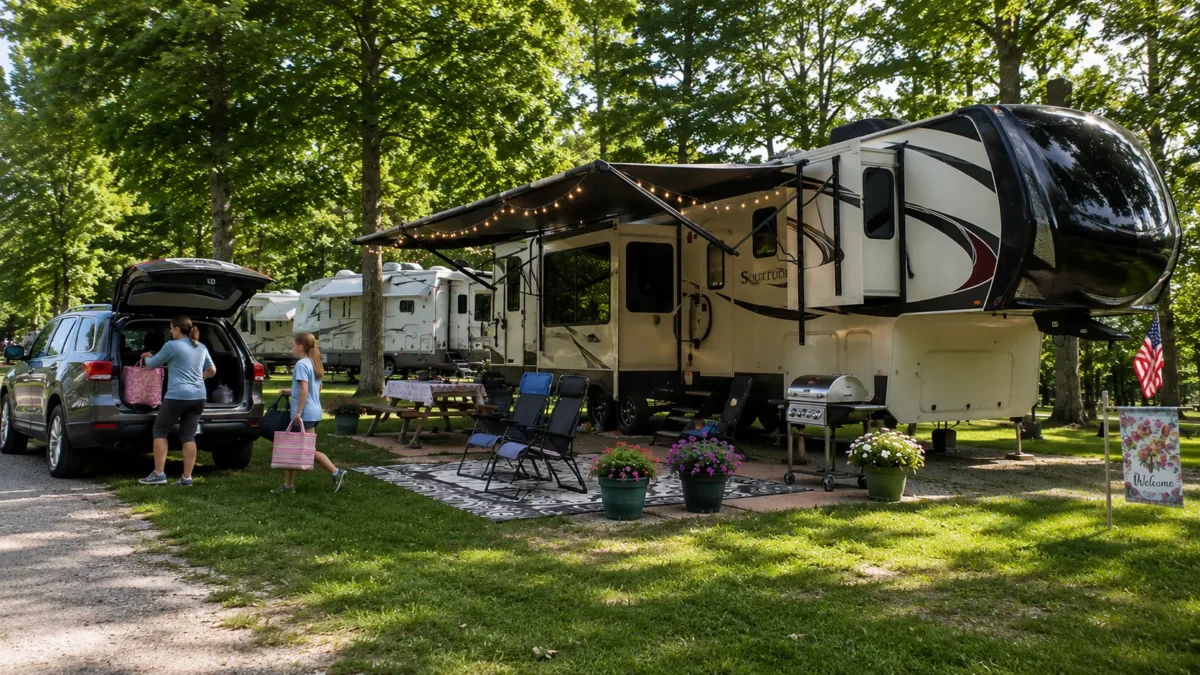
A seasonal RV site is a campsite you lease for a full season, usually spring through fall, and leave your RV parked the whole time. Instead of booking night by night, you pay once for the season, keep the same assigned spot, and come and go whenever you want. No hitching up, no tearing down, no scramble for a reservation on a Friday afternoon. The rig is already there, leveled and waiting.
It’s a setup that a lot of our campers at Copake Camping Resort settle into once they realize how much of the Hudson Valley they want to see over a summer.
How a seasonal RV site actually works
A seasonal site runs on a lease, not a nightly booking. You sign a written agreement with start and end dates, pay a deposit, and get an assigned site that’s yours for the whole season. Most seasons run from around April or May through October or November, though the exact dates depend on the campground and the climate.
Once you’re set up, the RV stays put. Your camp chairs stay out. Your outdoor rug, your string lights, your grill: all of it stays exactly where you left it. When the weekend comes, you drive up with a bag of clothes and some groceries, and you’re camping in ten minutes.
Compare that to a transient stay, where you reserve specific dates, arrive, level and hook up, then break it all back down before you leave. Every trip starts and ends with setup. With a seasonal site, you do that work once in the spring and undo it once in the fall.
There’s usually an application step, too. Campgrounds want to know your rig’s size and age, how many people and pets are coming, and that you’ve read the community rules. That approval step is also what keeps the vibe consistent from one site to the next, which brings up a fair question: how is this different from just booking a long stay?
Seasonal vs. transient sites: what’s the difference?
The core difference is commitment and what you get for it. A seasonal site is one payment for months of access to a fixed spot; a transient site is pay-as-you-go for specific dates. Here’s how they stack up on the things that actually matter day to day:
| What to compare | Seasonal site | Transient (short-term) site |
| Length of stay | A full season (often ~5–7 months) | A night, a weekend, or a week |
| How you book | Application + lease + deposit | Online or phone reservation per trip |
| Cost structure | One seasonal fee, sometimes plus metered electric | Nightly or weekly rate, usually all-in |
| Leave the RV set up? | Yes, all season | No, you set up and tear down each visit |
| Same spot every time | Yes, your assigned site | Whatever’s available when you book |
| Travel flexibility | You’re anchored to one campground | Free to visit somewhere new each trip |
| Community | You get to know your neighbors | Faces change from trip to trip |
What’s included, and what “metered electric” really means
Most seasonal fees cover water, sewer, and access to the campground’s amenities. Electricity is the one that varies, and it’s the one to nail down in writing before you sign. Nightly and weekly stays almost always bundle power into the flat rate, but on many seasonal and long-term sites, it’s metered, billed separately for exactly what you use on top of the site fee.
That’s the surprise RVers warn each other about on forums like iRV2 and The RV Forum: check whether electric is included or metered, and get the per-kilowatt-hour rate up front.
The bill itself depends on your rig, the weather, and how hard you run the air conditioning. Running two AC units through a hot stretch can add roughly $150 to $300 to a month’s electric on a metered site, with typical rates around $0.11 to $0.22 per kilowatt-hour depending on the park and state, according to RV cost guides tracking 2026 pricing. So ask directly: is the electric metered or included, what’s the rate, and are there separate charges for trash, propane, or an extra vehicle?
How much does a seasonal RV site cost?
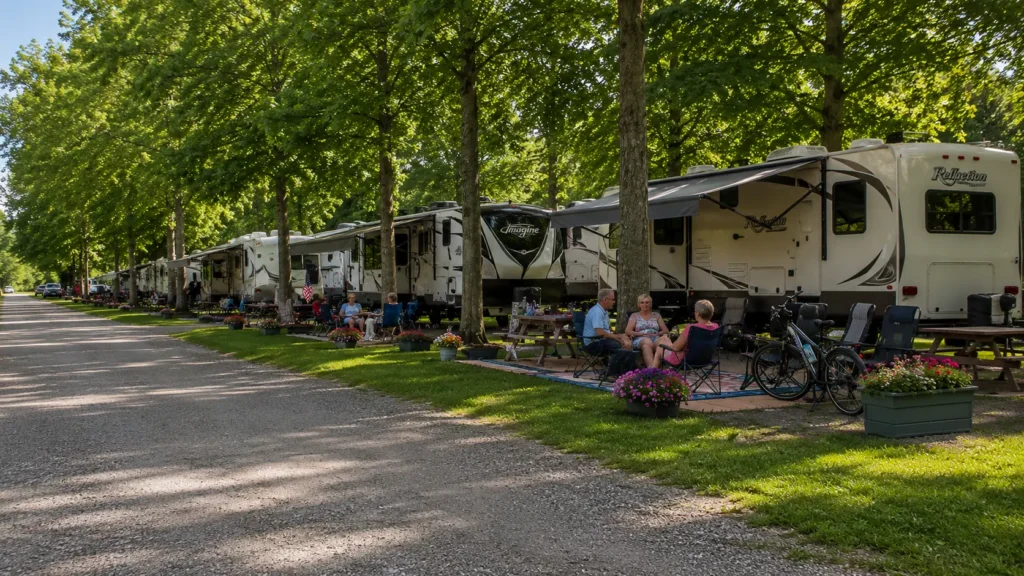
Seasonal pricing varies a lot by region, hookups, and amenities, but full-hookup seasonal sites commonly run in the low thousands for the season. In the Northeast, published seasonal RV parks advertise rates in the range of roughly $3,500 to $4,500 for the season for full-hookup sites. Monthly long-term sites, a close cousin, often land between $500 and $1,200 or more per month, depending on location and whether utilities are included.
The real question isn’t the sticker price, though. It’s the cost per use. Here’s the math that makes seasonal sites click for a lot of people.
Say a full-hookup transient site costs around $50 a night. Camp every weekend from May through September, and you’re looking at about 40 nights, or roughly $2,000, just in site fees. And that’s if you can even get the dates you want. A seasonal site at that same campground might run $2,500 for the season. On paper, that’s more. But a seasonal site has no per-night ceiling: go every weekend plus a few weekdays, and you might rack up 60 or 70 nights, dropping your effective cost per night to $35 or less. The more you use it, the cheaper each trip gets.
One more thing worth adding to the ledger: if you already pay to store your RV somewhere off-season, a seasonal site can absorb that cost, since your rig lives at the campground instead of a storage lot. For RVers stuck in an HOA that bans driveway parking, that alone can tip the math.
Is a seasonal RV site worth it? Who it’s for, and who it isn’t
Worth it depends entirely on how you camp. A seasonal site rewards repetition and punishes wanderlust, so the honest answer runs both ways.
Here’s who tends to love it:
- The weekend regular. You’ve got a campground within a couple of hours of home, and you’d go most weekends if setup weren’t such a drag. A seasonal site removes the drag. This is the single best fit.
- The family is building a tradition. You want the kids to grow up with the summer spot, the same pool, the same friends, the same fire ring year after year. That sense of place is hard to buy any other way.
- The RVer is already paying for storage. If your rig sits in a paid lot half the year anyway, a seasonal site often costs less than you’d think once you subtract what you’re already spending.
- The time-strapped camper. Short weekends get shorter once you factor in setup and teardown. When the RV is already parked and stocked, a Friday-after-work escape actually becomes worth the drive.
And here’s who should probably stick with transient sites. If you love visiting new campgrounds and seeing new country, a seasonal site locks you to one place, and that freedom is the whole point of an RV for you. If you only get away a week or two a year, paying for a full season you won’t use doesn’t add up. And if you’re not yet sure a seasonal campground is right for you, don’t commit a season to it on a hunch. Book a couple of weeks there first and see how it feels before you sign anything.
There’s also a bigger misunderstanding worth clearing up: people sometimes assume a seasonal site is a backdoor to living in an RV full-time. It usually isn’t.
Seasonal site vs. living in your RV: an important distinction
A seasonal site is a recreational arrangement, not a permanent residence. Most campgrounds don’t let you claim a seasonal site as your legal address, and the lease is written as a seasonal permit, not a lease-to-live. That distinction carries real legal weight, so it’s worth understanding before you make plans around it.
Zoning and housing codes across the U.S. generally treat RVs as temporary-use vehicles, not dwellings. Many states and counties limit or prohibit using an RV as a full-time home, and the Northeast tends to be on the stricter end. New York is among the states where local codes often restrict RV living as a permanent residence, which is why campgrounds here structure seasonal stays as recreational use with a defined season.
In practice, that means a seasonal site is your getaway, not your mailing address. You’ll still keep a permanent home elsewhere for taxes, licensing, and mail. That’s not a loophole being closed on you it’s simply what “seasonal” means, and it’s part of why the season has a start and end date in the first place.
None of that takes away from what a seasonal site is genuinely great at: giving you a settled, ready-to-go outdoor home base for the best months of the year. And that’s exactly what seasonal camping looks like in the Hudson Valley.
Seasonal camping in the Hudson Valley at Copake Camping Resort
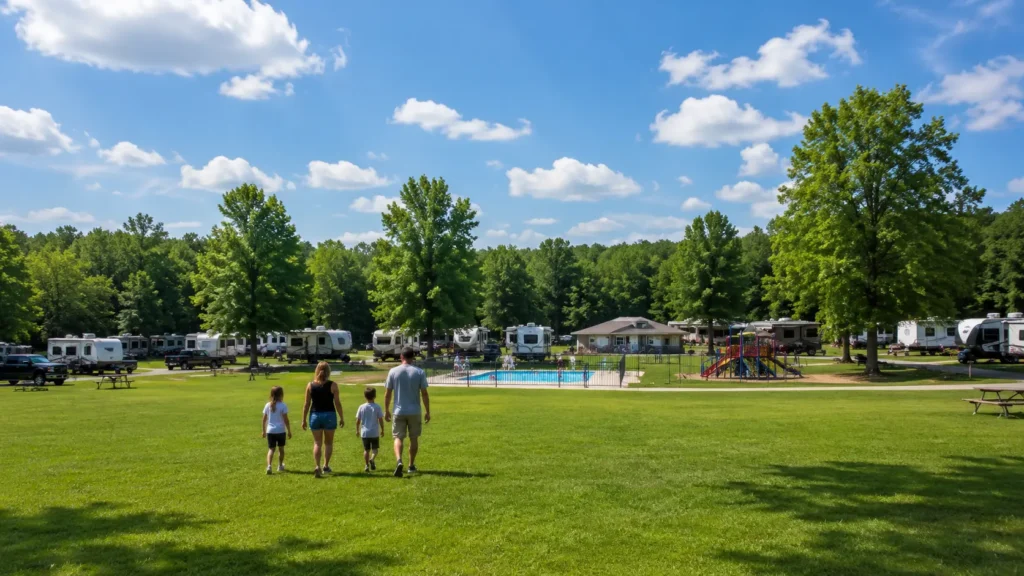
If you’re weighing a seasonal site within driving distance of New York City, Westchester, Connecticut, or northern New Jersey, Copake Camping Resort sits in a genuinely convenient corner of the Hudson Valley. We’re in Copake, in Columbia County, near where New York meets Connecticut and Massachusetts close enough for a Friday-night arrival, far enough to feel like a real escape.
Our RV sites are built for exactly the kind of camper who’s thinking seasonal. All of our full-hookup RV sites run 50-amp service with water, electric, sewer, cable, and Wi-Fi, and they’re Big Rig friendly, with back-in, pull-thru, and deluxe patio options. That matters over a full season, when you want infrastructure you can count on week after week rather than a spot that barely fits your rig.
A season here isn’t just a parking spot, either. There’s a heated pool, a multi-sport court, a dog park, mini golf, and a calendar of themed weekends and live entertainment that gives families a reason to come back every weekend. It’s the difference between somewhere to store the RV and somewhere your family actually wants to be. And when the season ends, on-site RV and boat storage is available (starting around $10/day or $150/month, depending on unit size) so your rig can stay close by instead of in a far-off lot.
Seasonal terms are best walked through in a real conversation. The season dates, what’s included, the deposit, the application, all of it is easier to sort out on a call, so the next step is simply to reach out. We’ll help you pick the right site and answer every question before you commit to a thing.
Frequently asked questions
Does a seasonal RV site include electricity?
Sometimes, but often not. Water and sewer are usually included in the seasonal fee, while electricity on seasonal and long-term sites is often metered and billed separately for what you actually use. Always confirm in writing whether power is included or metered, and get the per-kilowatt-hour rate before you sign.
How long is a “season”?
Most seasons run roughly from April or May through October or November, depending on the campground and the local climate. Some parks offer year-round seasonal sites in warmer regions. Always check the exact start and end dates with the specific campground, since they set their own calendar.
Can I leave my RV on-site over the winter?
Often yes, through off-season storage, though it’s usually a separate arrangement from the seasonal lease. Many campgrounds offer on-site storage so your rig stays put between seasons. Ask what off-season storage costs and whether your seasonal site or a separate storage area is used.
Can I live at a seasonal site full-time?
Generally no. A seasonal site is recreational use, not a permanent residence, and most campgrounds won’t let you claim it as a legal address. Local zoning often restricts full-time RV living, and the Northeast tends to be strict. Plan to keep a permanent home address elsewhere.
Is a seasonal site cheaper than paying nightly?
It usually is if you camp often. As a rule of thumb, if you’d realistically spend 15 or more weekends at the same campground in a season, the one-time seasonal fee beats stacking up nightly rates. Camp only a week or two a year, and paying per night makes more sense.
Can I bring my dog and my family?
At most family campgrounds, yes, though pet and guest rules vary, so confirm them up front. At Copake, we’re pet-friendly, with an on-site dog park, and the whole resort is built around family stays. Ask about pet limits and guest policies when you inquire about a seasonal site.
A seasonal RV site isn’t for everyone, and that’s the honest truth of it. But if you’ve got a stretch of the Hudson Valley you already love and a family that would happily spend the summer there, it turns camping from a project into a habit. The best way to find out if it fits is to talk it through.