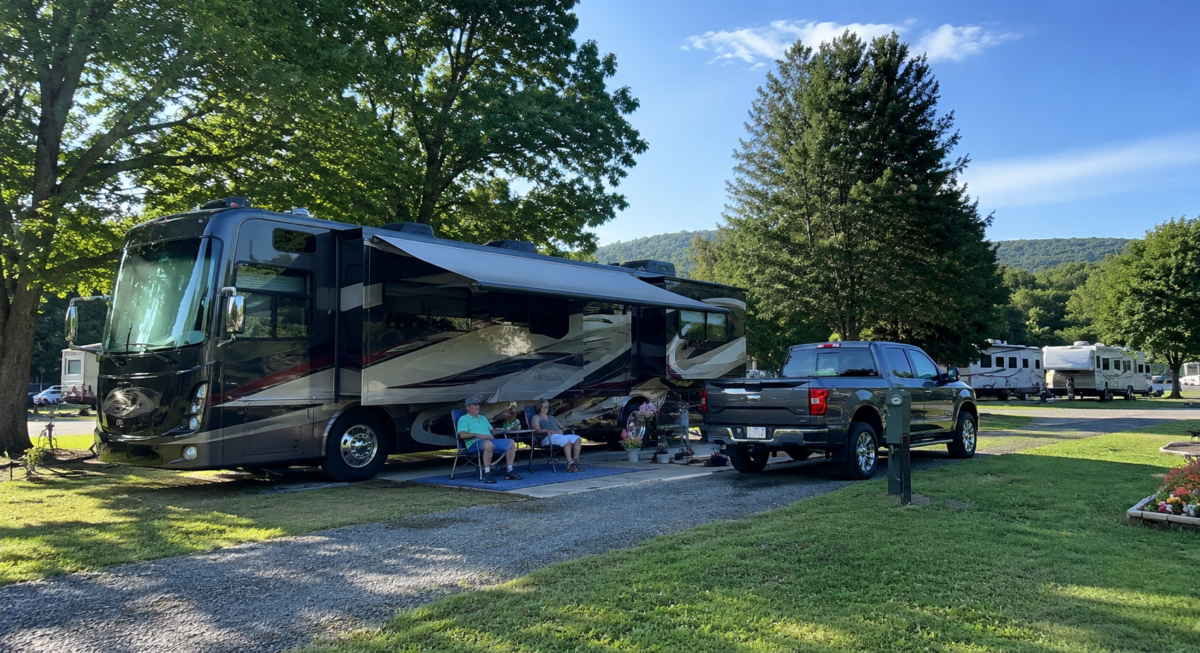
“Big Rig Friendly” shows up on almost every campground website within driving distance of New York City. A 40-foot Class A with a toad in tow needs real room to maneuver, real amperage to run its appliances, and a pull-thru that’s actually a pull-thru and not a tight loop dressed up as one.
Plenty of campgrounds that call themselves big-rig-friendly were built for 30-foot travel trailers, with the “big rig” sites added near the back fence as an afterthought. If you’ve ever pulled in expecting a straight shot through and ended up working a three-point turn around a stump, you already know the gap between the website and the gravel.
Here’s what actually separates a campground that can fit your rig from one that just says it can, and where in the Hudson Valley that distinction holds up, including at Copake Camping Resort in Columbia County, NY.
What “Big Rig Friendly” Actually Needs to Mean
Start with electrical, since it’s the fastest way to find out if a park is exaggerating.
50-amp service, on every site, not just some of them.
A 30-amp site can power a travel trailer just fine, but ask it to run a residential fridge, two air conditioners, and a microwave at the same time, and you’ll find the breaker before you find a third outlet. If a park’s website says “30/50-amp available,” that “available” is doing a lot of work. It usually means some sites have it, and some don’t, and you won’t know which until after you’ve paid the deposit.
Length and width that account for the whole rig, not just the coach.
RV forums are full of debate over the exact number, but the rough consensus among full-timers is that a 40-foot coach with a toad needs somewhere between 65 and 70 feet of site length to park comfortably without a bumper hanging into the road. Width matters just as much once slide-outs are out. Figure on losing roughly 3 feet of usable space on each side that extends, and check what the park considers “fire clearance” between sites, which usually runs 6 to 8 feet. A site marketed as “spacious” without a number attached isn’t telling you anything.
A pull-thru that’s actually a pull-thru.
This one catches experienced RVers off guard more than almost anything else. Some parks label a site “pull-thru” when it’s really a loop. You drive in, and the only way out is a slow bend around a curve that a 45-foot rig has to work its way through. If a site description doesn’t make clear whether you’re driving straight through or curving around something, call and ask before you commit.
Site levelness and real spacing between rigs.
Reviews across Hudson Valley–area campgrounds mention unlevel pads often enough that it’s worth asking directly, especially for stays longer than a night or two. A site can be full hookup and still be a hassle if you’re stacking leveling blocks every evening.
Where Big Rigs Actually Fit Near New York: Copake Camping Resort
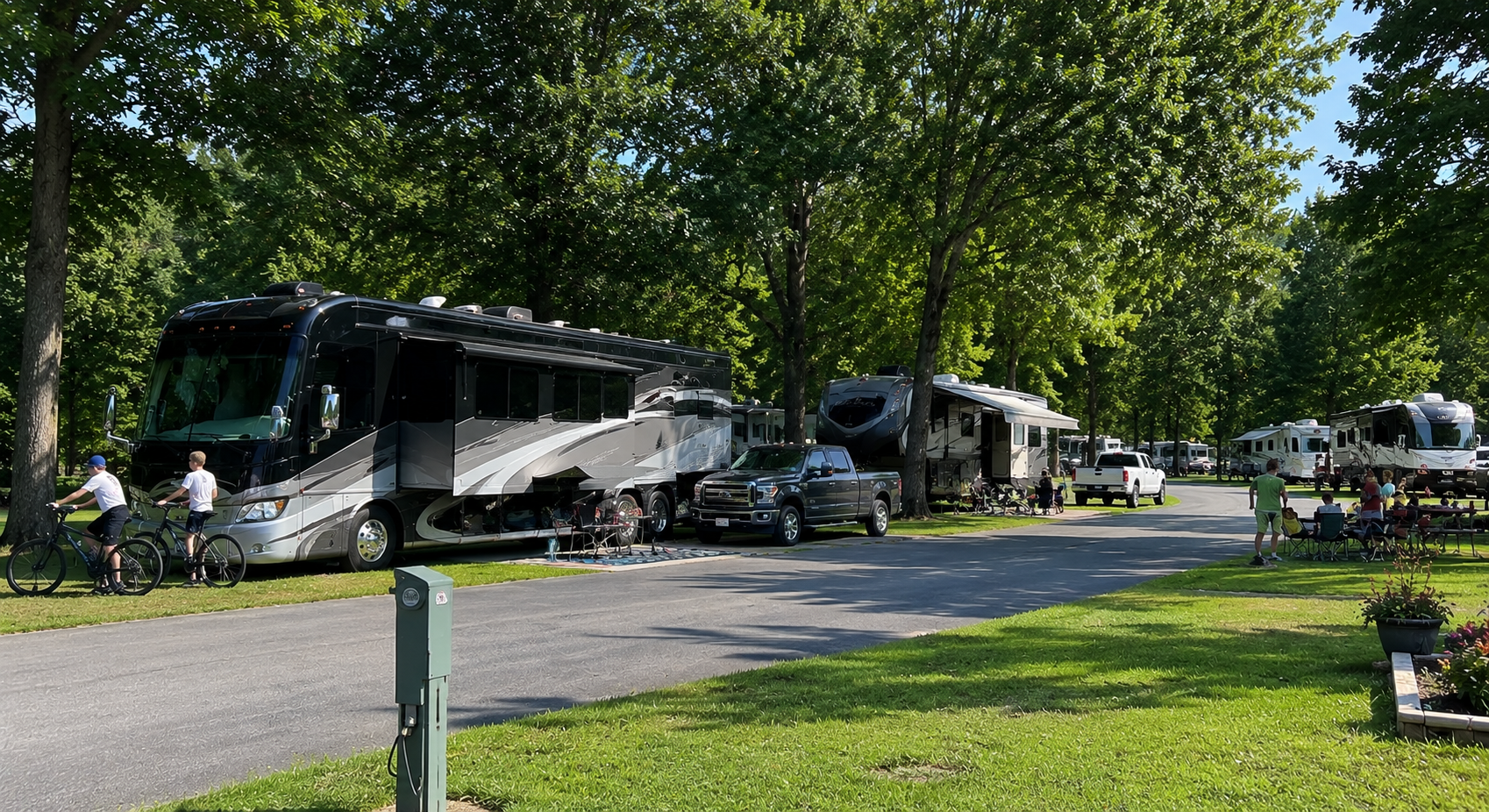
Copake Camping Resort sits in Columbia County, right in that tri-state corridor, and the RV side of the property is built specifically around big rigs rather than treating them as an afterthought.
All 229 RV sites offer 50-amp full hookup service, water, electric, sewer, and cable. Not a mixed tier where some campers get lucky, and others don’t. You can choose a back-in, a pull-thru, or a deluxe patio site depending on how you want to set up.
Off-season storage is on-site too, for the rig or the boat, starting at $10 a day or $150 a month. It’s a detail none of the Catskills-area resorts in this guide list on their own sites. If you’re a seasonal camper who’d rather not tow the rig home every fall, that’s worth knowing before you book anywhere else.
Once you’re parked, Columbia County offers a solid base for day trips. Bash Bish Falls, Massachusetts’s tallest single-drop waterfall, is about ten minutes away. Hudson-Chatham Winery, Harvest Spirits, Hillrock Estate Distillery, and Chatham Brewing are all close enough for an afternoon without breaking camp. Copake’s been running since 2010, carries an 8.4 out of 10 on RV Life across 79 reviews, and has built a seasonal camper base that sticks around year after year instead of passing through once.
Before You Book: A Short Pre-Arrival Checklist
A few things take thirty seconds to ask and save a full afternoon of stress later.
- Know your total rig length, tow vehicle and toad included, not just the coach.
- Confirm 50-amp is on the specific site you’re being assigned, not just “available somewhere at the park.”
- Ask directly whether the pull-thru is a true straight-through or a loop.
- If you’re staying more than a couple of nights, ask about leveling and shade before you arrive, not after you’ve set up.
- Book early. Big rig sites are a smaller slice of most campgrounds’ inventory, and summer weekends fill them first.
Frequently Asked Questions For Big Rig RV Camping Near New York
Is 30-amp enough for a big rig?
For a smaller travel trailer, often yes. For a Class A or large fifth-wheel running multiple air conditioners and a residential fridge, 30-amp usually means managing your appliance load carefully to avoid tripping the breaker. 50-amp removes that math entirely.
What’s the actual difference between a pull-thru and a back-in for a large RV?
A pull-thru lets you drive straight in and straight out without unhitching a toad or backing into position, which is useful for an overnight stop. A back-in takes more setup but often comes with more privacy and space. The distinction that actually matters for big rigs is whether a “pull-thru” is a straight shot or a loop, since loops can be harder to manage than a standard back-in.
Does Copake have storage if I’m not ready to take my RV home for the winter?
Yes. Copake offers on-site RV and boat storage starting at $10 a day or $150 a month, depending on the size of your unit, which is useful if you’re a seasonal camper who’d rather not tow home every fall.
How far is Copake Camping Resort from New York City?
Copake sits in Columbia County, within drive range of the NYC metro area, Westchester, Connecticut, and western Massachusetts. Close enough for a weekend, far enough to feel like you’ve actually left.