
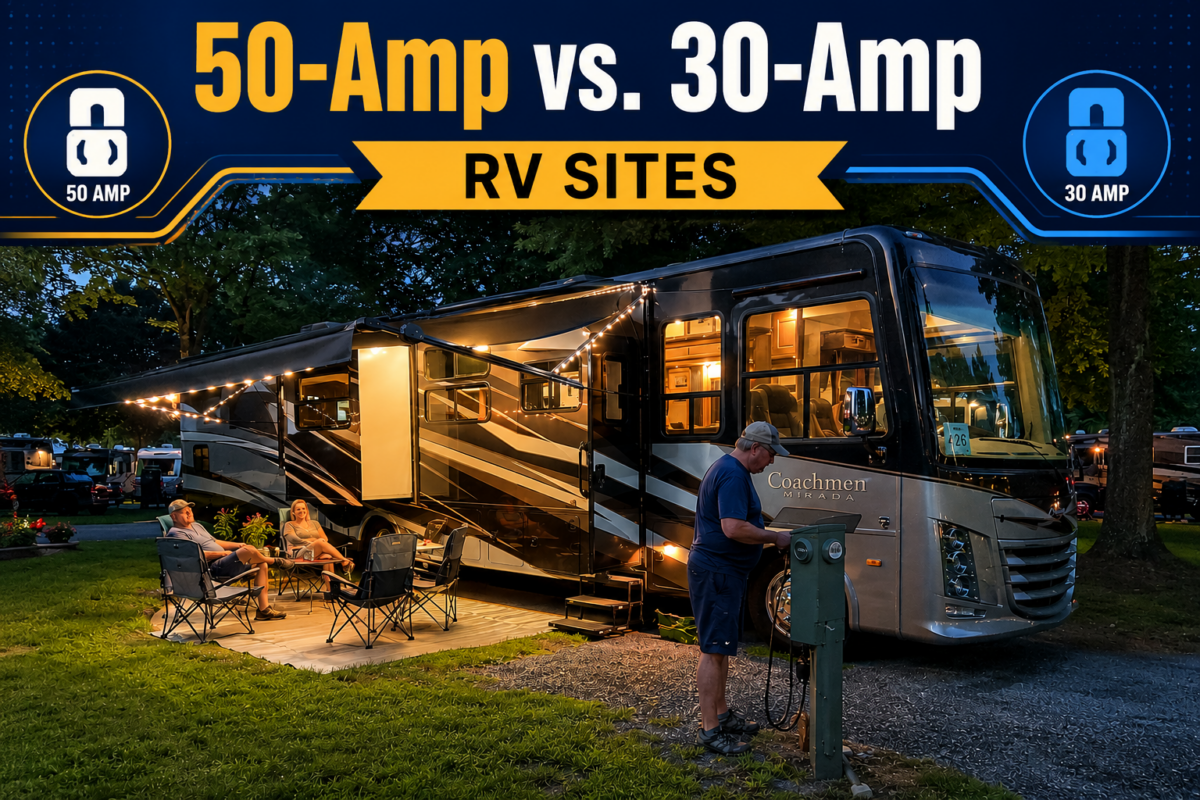
A breaker trips at nine at night, the air conditioner cuts out, and someone’s standing by the pedestal trying to remember what else was running. That’s usually the moment RVers find out which kind of power they actually have. A 30-amp site runs one air conditioner and the basics. A 50-amp site runs two air conditioners, an electric water heater, and a washer or dryer simultaneously without anyone juggling appliances.
Which one a rig needs comes down to what’s actually plugged in, not how big the RV looks. At Copake Camping Resort, every one of the 229 RV sites comes with 50-amp service built in, so there’s no guessing which one a guest will get. If the basics of full hookups are already familiar, amperage is what actually trips people up.
What 30-Amp and 50-Amp Actually Mean
Amperage is how much electrical current a site, or your RV, can handle at once. A 30-amp site tops out at 3,600 watts. A 50-amp site can deliver up to 12,000 watts because it runs on two separate power lines instead of one. That gap is the whole reason this matters: 3,600 watts covers one air conditioner and the basics, while 12,000 watts covers a lot more before anything trips.
What Each One Can Actually Run
A 13,500 BTU air conditioner pulls around 1,600 watts on its own. Add a microwave at roughly 1,000 watts, and an electric water heater at another 1,000, and a 30-amp site is already close to its limit before anyone’s touched a hair dryer. That’s not because a 30-amp RV is underpowered. It’s built around one air conditioner and a manageable list of things running at a time, on purpose.
Fifty-amp sites change that math. Two air conditioners, an electric water heater, a microwave, and a washer or dryer can all run at the same time without anyone having to keep a mental checklist of what’s currently on. For a family packing a weekend full of activities, or a multi-family group sharing one site for a reunion, that extra room is the difference between a comfortable stay and a lot of switching things on and off.
The Plug Difference (and Why You Can’t Just Force It)
You can usually tell which kind of service a site has before checking the pedestal. A 30-amp plug, technically a NEMA TT-30, has three prongs and runs power through a single 120-volt line. A 50-amp plug, a NEMA 14-50, has four prongs and splits its power across two separate 120-volt lines, often called legs.
This is where many explanations leave out a key detail. A 50-amp site doesn’t hand you a flat 12,000 watts to pull from wherever you want. Each leg caps out at 6,000 watts on its own, and the two legs share a single trip bar, so overloading one side shuts off both, even if the other leg wasn’t anywhere near its limit. That’s why most large RVs split their air conditioners across the two legs in the first place.
It’s also worth protecting whichever connection you’re using. A bad pedestal or a power surge can damage anything plugged into it, on 30-amp or 50-amp alike, so a surge protector at the connection is a habit worth having, no matter which service you’re on.
Using a Dog Bone Adapter When It Works and When It Doesn’t
A dog-bone adapter lets a 30-amp RV plug fit into a 50-amp pedestal, or a 50-amp RV plug fit into a 30-amp pedestal, by changing the plug shape on one end. It doesn’t change how much power your RV can actually use. A 30-amp RV connected to a 50-amp site through an adapter is still capped at 3,600 watts; the adapter gets you connected, it doesn’t upgrade your rig.
The reverse holds too. A 50-amp RV running through an adapter on a 30-amp site is limited to whatever that single 30-amp line provides, so it’s worth managing appliances the same way you would on a smaller rig.
Why This Question Comes Up So Much at Hudson Valley Campgrounds
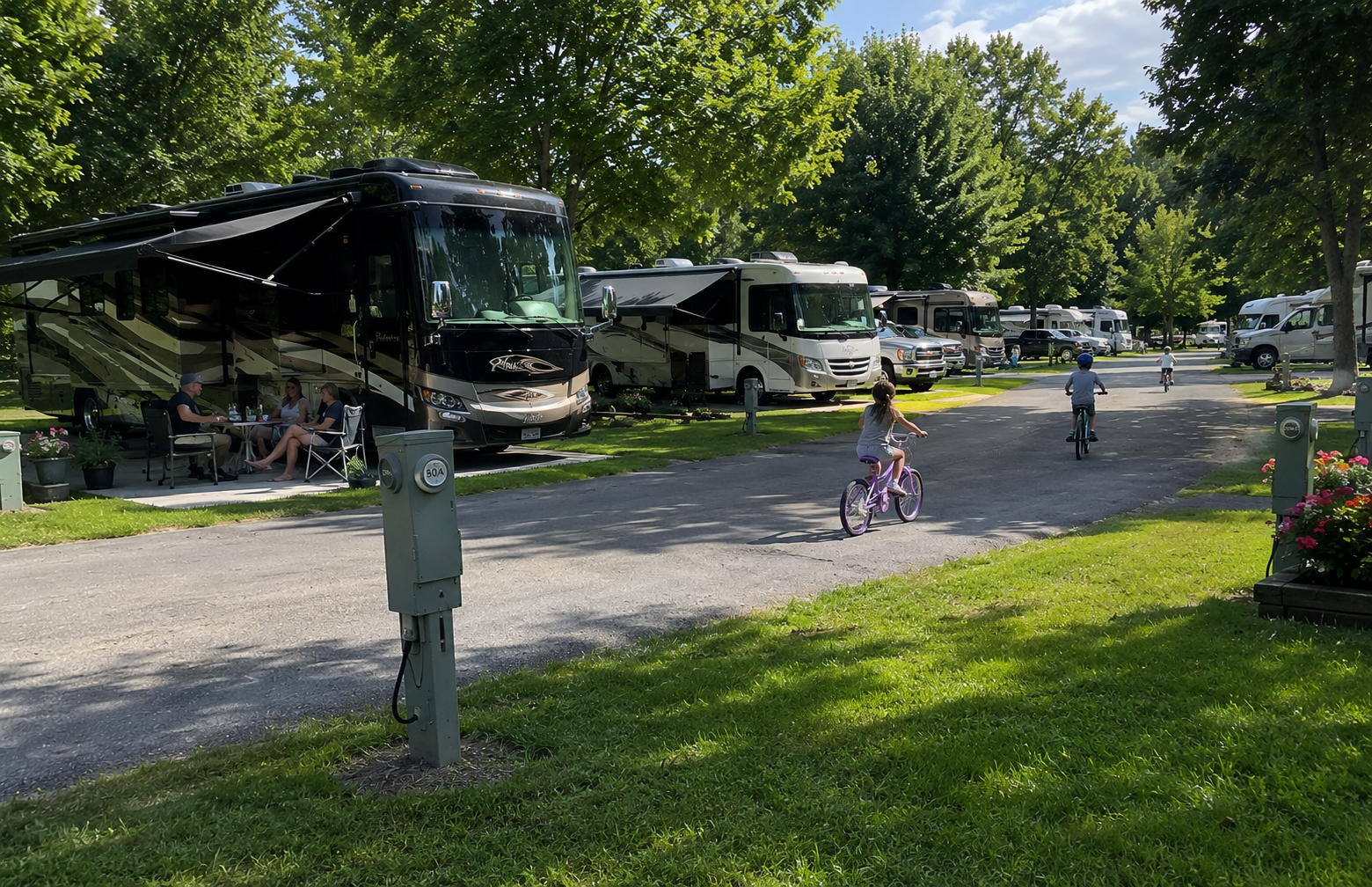
Part of the reason 30-amp versus 50-amp keeps coming up isn’t really about the wiring. It’s about not knowing what you’ll get until you arrive. Some Hudson Valley campgrounds mix 30-amp and 50-amp sites across the property, offer 50-amp as an upgrade, or have it available only on a handful of pads. That’s a workable way to run a campground, but it puts the guest in the position of guessing or calling ahead just to confirm what their specific site will actually have.
At Copake Camping Resort, that guessing game doesn’t come up.
All 229 RV sites are full hookup with 50-amp service built in. There’s no separate 30-amp category to land on by mistake, and no upgrade to request. Whatever site gets booked, the power is already there.
How to Tell Which One Your RV Needs
Start with the data plate near the power inlet, or the owner’s manual; it states the amperage outright. If that’s not handy, count the air conditioners. One unit generally runs fine on 30-amp. Two units, or one unit plus an electric water heater and a few other large draws, points toward needing 50-amp.
The breaker panel is another tell. A single row of breakers usually means a 30-amp setup. A split panel, with breakers divided across two sides, means the RV is wired for 50-amp.
None of this takes guesswork once it’s clear where to look. It just means checking the rig instead of assuming based on size plenty of mid-size trailers run 50-amp, and plenty of larger ones still run 30.
Booking the Right Site for Your Rig
Every RV site at Copake Camping Resort is full hookup, with water, 50-amp electric, sewer, Wi-Fi, and cable included, across back-in, pull-thru, and deluxe patio options. If it’s not clear which site style fits a rig best, call, and we’ll help pick the right one. Reserve a site, and the power question is already settled before arrival.
Common Questions
Do I need 50-amp for my RV?
Check the owner’s manual or the data plate by the power inlet for the exact amperage the RV is built for. As a general rule, two air conditioners or a houseful of larger appliances call for 50-amp service; one air conditioner and the basics usually run fine on 30-amp service.
Can a 30-amp RV plug into a 50-amp site?
Yes, with a dog bone adapter. The RV still only draws the 3,600 watts it’s built for, since the adapter changes the plug shape rather than the power available to the rig.
Will I end up on a 30-amp site by accident at Copake?
No. Every one of the 229 RV sites at Copake Camping Resort is full hookup with 50-amp service as standard, so there’s no separate 30-amp category to land on.
What happens if the amp limit gets exceeded?
The breaker trips, cutting power. It’s a safety feature, not a malfunction. Switch off a few things, reset the breaker at the pedestal, and the power comes back.